
Aphasia
On cancer and stupidity
The trade off for having a job that requires the entirety of your intellectual focus is that it is distracting. You can’t afford to make mistakes when you teach, especially at a place like Berkeley, where your students are smarter than you and will also remind you of that with frequency. The things these people say in class and in their essays! They knock me flat quite often.
But if you make one mistake on the website, on the syllabus, on the dates for an assignment? It causes a cascade of additional mistakes. The course website is running on 15-year-old legacy code. Last week it duplicated one assignment without my knowledge, causing my students to see two things due when there was only one thing due. Then I set it to give them five points for a completed assignment, and it gave everyone four. Did the students inform me about both of these things within seconds of noticing them? They sure did. Like I said, they are smarter than me.
They are also somewhere between 18 and 22 years old, for the most part (shoutout to the Berkeley OWLs – Older Wiser Learners), and their brains have not been subjected to decades’ worth of chemical bombardment squeezed into a compressed timeline. This semester, like every semester, has been busy, so busy that I forgot that February marked two years since I finished the cancer triathlon: surgery, chemo, radiation. Now, for those of us unlucky enough to have hormone-driven cancers, there’s the you-will-take-this forever pills that are pretty much the only thing pushing against whatever cancer cells might still be circulating in my body and theoretically keeping it from coming back.
What my job reminds me of, so often, is that cancer made me stupid.
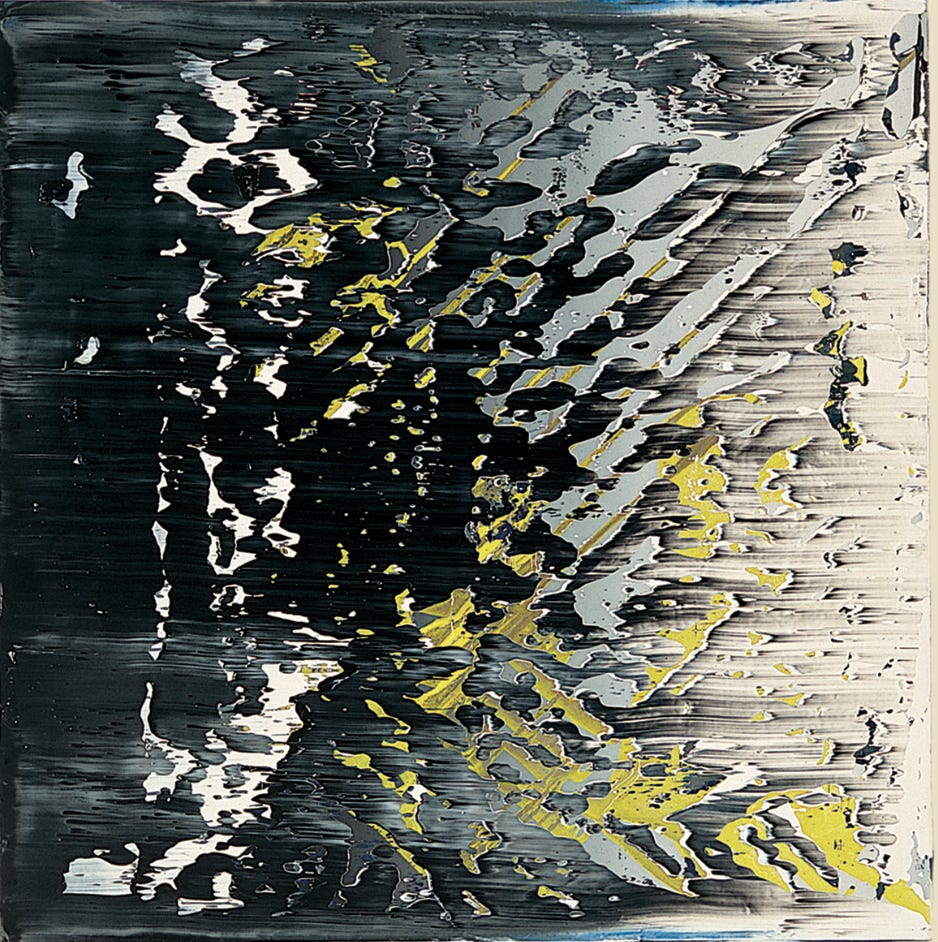
Gerhard Richter, Abstraktes Bild, 1988 (SFMoMA)
Perhaps this is what it’s like for people who were stunning-looking as young adults but who have to face the body horror of gravity and collagen loss and hair thinning. Attractive people wake up one day and, apparently, look like one of those terrifying folk art dolls with a shriveled apple for a head. Smart people wake up one day and realize that it’s been three years since they were able to read a demanding book from cover to cover without stopping every twenty pages or so to rest.
When I say cancer made me stupid I mean I cannot remember things, lose words in conversation and in class, struggle to get through one of those 8000 word New Yorker investigations, show up for haircuts on the wrong day in spite of three calendar reminders and a constantly pinging Apple Watch (twice a day reminders to take your meds, take your meds, take your meds and still, at week’s end the pill tray is littered with forgotten meds), walk out the door without wallet or keys or both, mispronounce a students’ name once and then repeat that multiple times throughout the semester or just stop saying their name out of fear of getting it wrong, watch movies and wake up the next day unable to recall anything about the characters or plot.
All of these things are, of course, monumentally important to being a writer, and to being a teacher of writing. Even writing these crumbly little missives leaves me depleted. My oncologist swears up and down that this is all normal. The chemo drugs, the horror show of months of diagnosis, years of sleep disrupted by nightmares, the long term impact of radiation, the daily hormone blockers, it all adds up and what it adds up to is dull-wittedness, a constant feeling of stupor, and the frustration that comes along with just not being very good at thinking.
Of course, it could always be worse. It always can be worse, and because of aging and the long-term effect of the meds, it will probably get worse. The upside might be that thinking less about things is sometimes a relief. This is why so many writers drink, and why so many writers stop writing. I’m not there yet, but writing less? It is sometimes also a relief. As to what it does to my teaching, yes, mistakes are made, confusion occurs, backtracking is frequent. It is, in many ways, like being a student again, with all of the attendant moments of anxiety, humiliation and disappointment. In this third decade of teaching, it is also like I have finally arrived in my final form: dotty and addled, quirky and forgetful, starting over again, every single day.