
Harmony
On Brian Wilson and enjoying things you’re bad at
When you grow up as a church kid, you grow up singing. The hymns of childhood were terrible, because they were not intricate compositions, but were being written on the fly. As the Catholic Church came out of Vatican II and moved the language of the liturgy from Latin into English, instead of rewriting the ancient chants in English, what we got instead were rewritings of Cat Steven’s “Morning has Broken” with “insert Jesus” choruses and anti-bangers written by sincere-looking priests holding acoustic guitars, except they could only play five or six chords, so everything sounded the same. And it sounded bad.
It has been a long time since I went to church regularly, but when I picked up a guitar last year and decided to start playing, there was one major problem. The songs I like to play sound better accompanied by a voice. My earliest nemesis was a girl in my fourth grade class who played the cello like me, but her cello had filigreed metal pegs and was bought and paid for whereas mine was banged and scratched and extracted from the back of the music room by our teacher. This girl was also in the San Francisco Girl’s Chorus, an ensemble that toured and performed for visiting dignitaries, and more importantly, rehearsed in San Francisco, a city my family rarely visited because entering San Francisco from Oakland requires paying an entry fee*.
So, of course, I had to audition for the San Francisco Girls Chorus. The problem was that even as a child, I could not sing. Having been trained in classical music I have decent pitch, a fairly solid foundation in reading music and a basic understanding of music theory. But when my mouth opens, something truly catastrophic happens. It’s either a kind of strained squalling sound in the soprano range, something that resembles a car with a blown out muffler in the alto range, and the muted croak of a large hairy animal dying from prolonged starvation in the contralto range. When I used to sing loudly in church because I actually love to sing, people would turn around with startled looks and the musical theater directors at school would keep handing me various instruments and saying “this is better for you.”
At the San Francisco Girls’ Chorus audition, the problem was that I knew two types of songs. The anti-banger Catholic hymns we sang in school and at church, and the folk-rock and country tunes of my parents’ slim vinyl collection. So my audition choices were either “Whiskey River” or “One Bread, One Body,” and, reader, I went with the hymn. That went about as well as you can imagine, and I stopped singing for many decades.
***
In various eras of our lives, we forge parasocial relationships with particular musicians who speak to the hurts and occasional joys we may be feeling during that time. An ex who was a music critic cautioned me never to listen retroactively, and to only consume music from the present tense, or else I would start aging faster. He was at that point a man in his late thirties who was the first person I ever met who was wildly enthusiastic about pop music, and he helped me understand that you didn’t have to have pretentious taste in music to say interesting things about it. He also had some crackpot theories about musical taste, like the aforementioned one that it can age you faster. In my experience nothing ages you faster than cigarettes and alcohol, but Keith Richards is still alive. To a certain extent, it did make sense that if your only love for a musician is because of nostalgia, that can easily land you sitting in a suburban Margaritaville staring into the oily remnants of your onion rings and questioning your life choices.
So I’m not defending only listening to music from the past, nor do I think that having a Big Chill style relationship with whatever was playing during the “best time of our lives, man” is in any way good for one’s mental health. What I will defend, however, is looking into music from the past as a process of discovering things you may have missed, an auditory treasure hunt. I was so obsessed with The Beatles’ White Album, for example, that I never really listened to Rubber Soul, which is a shorter, tighter, more cohesive album. When it comes to The Beach Boys, I’d only ever listened to Pet Sounds, and had never heard any of the tracks that Brian Wilson wrote for the Smile album, which was just too weird for the other Beach Boys and wound up being discarded.
Over the past few months I’ve been having the very enlightening experience of listening to some of that weird Beach Boys material, from the last three tracks of the Surf’s Up album to “Feel Flows” (which I’m pretty sure has been widely sampled in hip hop) to discovering that Brian Wilson in particular really suffered before his death from long-term effects of Covid last June. But all of the Wilson brothers in The Beach Boys were tormented in one way or another by their alcoholic, verbally abusive father Murry, a failed musician who tried to live vicariously through their success. There’s a recording of Murry Wilson showing up drunk out of his mind in the studio while the band is recording, and Brian Wilson – at the time wrecked on drugs himself which exacerbated his schizo-affective disorder – is the one who has to talk down his ranting dad.
As in many voyages through popular culture that I’ve been on, this one started with a man saying something rude and dumb. Late last year, Quentin Tarantino referred to the actor Paul Dano as “the weakest fucking actor in SAG,” which was confusing because Paul Dano is usually the best thing about most movies he’s in. This in turn made me realize I’d never seen Love and Mercy, the Brian Wilson biopic where Paul Dano plays the young Brian Wilson and John Cusack plays the middle aged Brian Wilson who’s trying to get out of the controlling relationship his psychiatrist had over his life and career. The movie is not great. Throughout it I kept shouting “shut up, Mike Love” because Mike Love is a human turd. Like many biopics it also has too many scenes that reminded me of the parody film Walk Hard and like many music biopics I’ve watched while stoned, Love and Mercy made me cackle at inappropriate moments (I was laughing like a hyena throughout that Timothy Chalamet Bob Dylan movie and the Berkeley boomers in the theater kept turning around trying to figure out why someone wasn’t being VERY SERIOUS about Bob Dylan, a man who was often so stoned he thought it was hilarious to walk around carrying a giant lightbulb).
Between watching Love and Mercy and listening to a few episodes of the A History of Rock and Roll Music in 500 Songs podcast about the Beach Boys (thanks again to my colleague Kim Freeman for introducing me to that podcast), I was now very into the Beach Boys, but the drugged out, bearded, damaged Beach Boys. Here comes the part that will surprise absolutely no one who was paying attention when the phrase “parasocial relationship” was dropped a few paragraphs back.
I started to really feel things about Brian Wilson, things ranging from admiration for his massive musical talent to empathy for his mental health struggles and addiction issues to a sad sense of recognition when his verbally abusive alcoholic dad died young because I too had a verbally abusive alcoholic dad who died young. In no other way do Brian Wilson and I have anything at all in common because Brian Wilson was a wealthy genius and I am a person of mediocre gifts who checks her bank account multiple times a day to make sure it’s not in overdraft. But when you find someone whose music is a tuning fork for your soul and discover you and that person have any crumb of similarity, you cleave to that person and cling to their work for dear life.
Of course, I still can’t sing. But a few weeks back, all at the same time, I was staring down my annual follow up cancer appointment, my 55th birthday, and the two year mark since I finished chemo and started radiation. And like the perfect cliche of a Californian, I was driving near a beach on a golden day, listening to Pet Sounds. When “I Just Wasn’t Made For These Times” came on, ears around me be damned, guess who was sing/shouting “they say I got brains but they ain’t doing me no good” over and over, and the next day I turned 55, and a few days after that the doctor said “you’re good to go for another year,” and over my shoulder, the Pacific ocean undulated in shades of blue and grey.
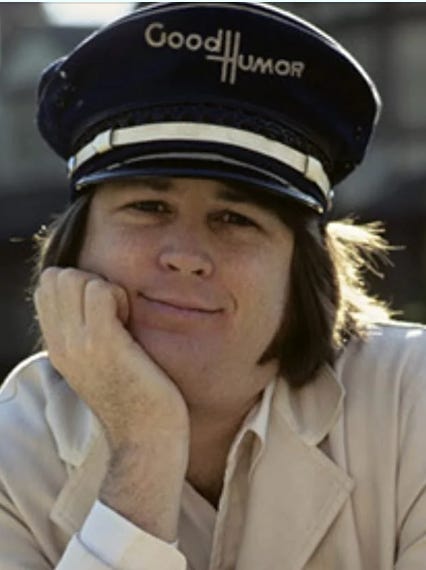
Maybe it was Brian Wilson’s miracle.
*That this is still the primary thing I dislike about San Francisco 40+ years later (other than those terrifying self-driving cars that are all over the city these days) which is how much everything costs. A burrito is twenty dollars. Coffee is eight dollars. And worst of all, it’s full of rich people who pay thousands of dollars to go to Burning Man and cosplay poverty while they complain nonstop about the city’s unhoused population. Today it costs nearly $20 round trip to enter and exit the city by train and the mayor is a nepo baby who bought his way into office whereas the mayor of Oakland is a left-leaning Black woman who was born in a segregated hospital and the only member of Congress who voted against the AUMF because she feared it would cause America “to embark on an open-ended war with neither an exit strategy nor a focused target” which seems very prescient in hindsight. I sure do love living in Oakland. Go Ballers.