
Kayfabe
On believing
Years back, there was a pattern among theologians, religion journalists and clergy on social media. Many of them were into posting about the usual things you’d suspect from that group of people: God memes, videos of popes making borderline rude comments, digs at megachurches that were mostly thinly veiled jealousy about the Sunday headcount.
But many of these (mostly) men of God had something else in common. They were obsessed with professional wrestling. In between exegesis of scriptures and hospital visits, they’d obsessively post about WWE Smackdown. When I asked what was behind this, a clergy member whose name is lost to the sands of time put it bluntly: it’s kayfabe.
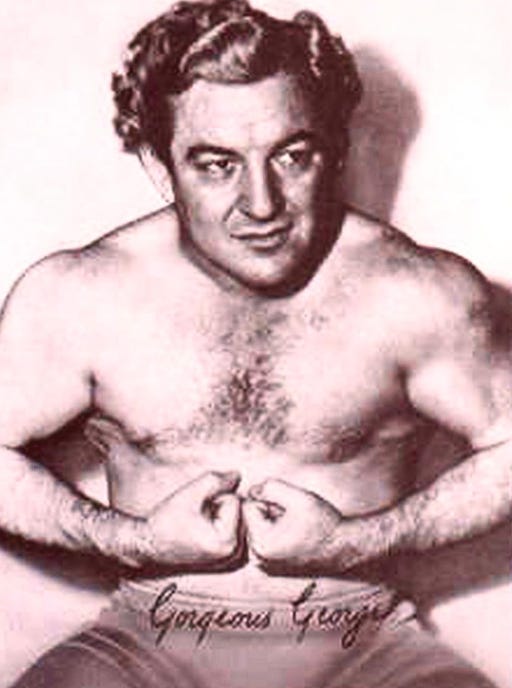
For those just as uninformed as I was, kayfabe is the unspoken contract between pro wrestlers and their audience that we know it’s all fake. The etymology of the word itself is unclear, but it might be based on carny speak for “be fake.” The characters they play both onstage and off, the wrestling moves themselves, the dramatic arcs played out between wrestlers over years and even decades are all acts of imagination. Before the internet, not talking about this was akin to a sacred vow. You didn’t say you knew it was fake even if you knew it was fake. In his memoir Chronicles, Bob Dylan claims that the wrestler Gorgeous George whispered words of encouragement to a young Bobby Zimmerman, but Dylan, too, is a notorious liar and a very skilled fake to the point that he turns it into something real.
For generations, pro wrestling has offered people a fantastical form of entertainment, built on the American need for escapist thrills. The internet made pro wrestling’s fake body slams and operatic feuds as transparent as glass. We all know it’s not real. But kayfabe persists. Without it, wrestling doesn’t work. People have to agree to act like it’s real or the entire premise falls apart.
And the same, of course, is true for religion.
***
A psychologist recently told me that when religious people get a life-threatening illness, they either lean into their faith even harder or they lose it. Doesn’t matter what their faith tradition is, where they live, or whether or not their ties to religion were woven throughout their lives or a once a year drop in. Facing the possible end of your life means previously existential questions become pressing ones. Religion either has the answers you’re looking for or it doesn’t. But to believe that it does, to some degree, you’ll always be participating in kayfabe.
Most religions have a creed or statement of belief. And in my work writing about religion, people have often told me they’ll say the words of a creed but mentally add a question mark at the end of each line, or just pick whichever lines they think sound the most reasonable. The Nicene Creed, the basis of a large swath of Western Christianity, contains some real head scratchers of things you’re supposed to believe, expressed, at least in the Catholic version, in baroque and sometimes nonsensical sounding language and convoluted sentence structures. Christianity’s first formal split occurred in the fourth century over a debate about the filioque, the line that says the Holy Spirit proceeds from the father and the son. But Eastern rite Christians believe the spirit proceeds only from the father. This arcane debate and others like it have dragged on for centuries but most of us just shrug and mutter the words.
Saying something, after all, is not the same thing as believing it.
***
When the doctors found my tumor (the tumor I grew, and therefore it belonged to me rather than being what in medical parlance is referred to as a tumor), many people I care for said “I’ll pray for you.” This was and is always welcome. And I also prayed furiously throughout diagnosis and the early part of treatment. My grandfather’s rosary was in my bag at every appointment. A Virgen de Guadeloupe pendant was around my neck at every biopsy, and prayer cards were in my wallet. I needed symbols. Other people’s prayers were (and are) always appreciated. The ones I was saying, however, didn’t seem to do any good. They did not tamp down the well of raging anxiety or offer reassurance when every test revealed more bad news.
So I stopped. And all of it, the edifice of writing and thinking and participation and effort I’d put into becoming a person who believed, it disappeared in a rockslide. A scattering of pebbles, followed by descending boulders, and finally, stillness.
***
Exvangelicals love to talk about “deconstruction.” Derrida used the term to describe the difference between text and meaning, but exvangelicals largely use it to talk about reframing former beliefs. But with so many people parting ways with evangelicalism, the word deconstruction has been used to the point of meaninglessness. When belief falls away, there is no term that captures what it’s like. The loss is beyond language.
In order to prevent this loss of belief, many people still clinging to religion have to participate in kayfabe. You act like you believe even if you don’t really know what believing means. “I believe in God” is the first line of the Nicene Creed, but what do we really mean when we say it? Our conceptions of God are individualistic and vastly different even within the same systems. Pete Hegseth’s God thinks we should bomb the shit out of countries that won’t bend to our will, but Oprah Winfrey’s God probably takes the form of a pastel cashmere sweatsuit with an Ozempic syringe in every pocket. I believe in God in the sense that I believe that there is likely something behind the creation of the universe we live in, a consolation in bleak times and something like a conscience that prods me to do better by others.
In California, this seems perfectly reasonable. We are very “woo,” and you are far more likely to find Oprah’s God everywhere in California that’s not Orange County or the State of Jefferson. That’s where you’ll find Pete Hegseth’s God. God, for me, mostly exists in the people God made (except for a few fellas clearly designed by Satan), maybe also in the natural world God perhaps had a hand in creating, but it’s all very abstract what that actually means if you ask but what do you really believe.
***
When you write about religion for an audience, you step out of the private space where you normally find God and say to the world, “here is what I believe,” except that nobody believes the same thing for the entirety of their lives, nor should they. To do so is to calcify into rigidity. So you can’t actually build a career on belief, nor should you. There is nothing more revolting than a “Christian influencer.” Faith and belief should fluctuate and develop and even fade or vanish with no guarantee of return. Otherwise, they wouldn’t really be faith or belief. And many people who like to read about religion don’t like to hear this. What they mostly want is reassurance.
But we’re all participating in kayfabe when we participate in religion because there will never be empirical evidence for anything you say you believe. We hold up the framework of religion by promising we won’t talk about the fact that there might not be a framework at all. It’s not the same as watching a bodyslam and knowing the guy isn’t really getting hurt, but it is close to cheering for something you’re pretty sure is constructed out of a rickety framework of wishes and hope.
Religion is a system and belief exists within the framework of whatever system you subscribe to, or it exists outside of the system, which is where the saints and prophets dwell. And outside of the system it is frightening. If you leave a community because it rejects you or because it makes it clear you will never really belong unless you bend yourself into unrecognizable shapes, there is no structure. But that is what facing death is like, too. “See you on the other side” is what I say before every surgery because I want to believe I will live, but also because I don’t know what death looks like and I’m a coward who wants to have it both ways: trust in life, but also the reassurance that there’s something after death. But cancer doesn’t allow you surety, which is the backbone of belief. Life for those of us who’ve been introduced to cancer will always be lived in liminality. The vagueness and doubt that becomes a core part of your identity might make it possible to believe. But it is hard to understand how you fit in with a system. Creeds ask for specifics. Cancer answers in the murky mysteries of genetics and DNA.
***
Maybe I’m done writing about religion, or maybe I’m just done writing about religion in the ways I’ve done it before, which was to point to the cracks in the system, to pry them open and see what pressures caused the fissures in the first place. Spending a decade writing about abuse was probably not a great idea; perhaps I should have written about trees or baseball or guitars, anything that feels solid and reassuring. But being alive means I can do that now, write about trees and baseball and guitars, even if doing so means I lose whatever platform or career built on the idea that I was “good” at writing about religion. Nobody really is, because belief, as it turns out, can’t really be captured in language. When you try, you wind up in syrupy cliché or in the danger zone of everything coming back to failure and blame. And neither of those things are really about God. If God exists, there are no words for it. Not even made up ones.