
Needs
The internet, polyamory, oversharing, and the howling void inside of us all
As a Gen Xer I have little vested in conversations about Millennials and their relationships to the internet. People my age have a mostly voyeuristic relationship with online culture. When a debate flares up about an internet celebrity, it’s definitely not about someone from Gen X. But it is deeply fascinating to follow the arc of these conversations. As a part of the generation that is old enough to have substantially carved out its identity offline, the only nostalgia I have for the early days of the internet, the same ones that were formative for Millennials, is nostalgia for the fact that you had to get up, leave your house, and go to a cafe or library to get online. There was your actual life, and then there was your online life. They were not the same thing.
But that same voyeuristic interest in things that are Very Online led me to spend a food chunk of time recently reading take after take about very Millennial, very online writer Lindy West’s new memoir. I’m going to skip the recap because you know how to use Google, but the compressed version is that a woman writer whose career began online wrote a memoir about polyamory. However, the discourse has mostly been focused on the fact that West’s polyamorous relationship seems to be, to some degree that varies based on the person writing about it, coerced. Her husband had a history of infidelity and made it clear that their relationship would not last unless he could continue to have sex with other people, something she was also theoretically allowed to do but seemed lukewarm about at best.
What’s striking about the conversations stirred up by this book and by the excerpts and interviews with West that I’ve read is not that people have strong opinions about polyamory, which of course they do. The surprise is a real sense of collective sorrow about how all of this went down. Even polyamorous people seem to agree that a person like West who greets the news of their partner’s infidelity with sobbing and fear is probably not the person who should be in a polyamorous relationship. When a writer whose brand was feminist bravado and brash humor describes herself as sad and confused because of a man, it’s a real bummer.
But we are all used to surrendering in the face of someone else’s needs. We just didn’t expect that a generation of people who grew up with the historical knowledge of everything that has ever happened at the tips of their fingers would keep doing this.
***
A friend recently recommended Taylor Tomlinson’s new standup special, “Prodigal Daughter.” Tomlinson, who is queer and grew up in a highly controlled Christian household, performs the set in a church. One repeated joke is that Christians hope for death because being united with God they want to “go lie down with Daddy.” The other running gags keep coming back to the idea of Christianity being a religion for submissives, but Tomlinson also admits she has family members and friends who are the “good kind” of Christians who “do it right,” meaning, I suppose, good old Faith, Hope and Love, which also happen to be useful qualities for sustaining a relationship.
I don’t know Lindy West’s religious background, but I did regularly read Jezebel, one of the websites where she she often wrote. And the attitude toward religion there and most Millennial-coded websites was that religion was a joke at best, and a destructive force to fight with both hands at the worst. It was during the rise of sites like Jezebel and the rise of Millennial feminism’s snarky braggadocio that my own questions about what it really means to be religious started to arise. But they arose with the fully formed adult knowledge that I agreed: religion was often a joke and often destructive. But religion also had its consolations and provided a sense of community. It filled a need. Kind of like the theory of polyamory, I suppose.
***
Last night I had a dream that a guy I know told me I had to drive him somewhere a few hours away or else I’d “get into trouble.” This is one of those guys who never seems to raise his voice. He is a totally nonthreatening dude.
So why was my subconscious doing this? Because I’d been binge reading stories about Lindy West’s memoir and the conversations about it, which I unwisely followed up by a binge viewing of the most recent season of the series Couples Therapy. The show features real couples seeing a real therapist – talk about a voyeur’s dream come true – and most recently included a throuple of two women and one man. The man had a habit of touching and stroking his secondary partner’s hair and arms to quiet her down and of dismissing her anxieties about his primary partner because he wanted to practice what he called “relationship anarchy.”
Suffice to say here was something most people would describe as manipulation, the argument that the two women had to be okay with receiving love dosed out in tiered levels based on their perceived value. One person needed sex and attention, and the other two were contorting themselves physically and mentally in order to meet those needs. There are a lot of poly people here in the Bay Area and a number of them seem to manage to make it work. But there is often, at least in straight relationships, whether monogamous or poly, this tendency for women in particular to agree to things they’re not entirely on board with because of someone else’s needs. Some people call that compromise. Some call it surrender. Some even call it the cost of devotion.
***
Sometimes a need is actually a want.
***
Perhaps this is just the tradeoff we make, in religion, in marriage, in our own heads. All of the books I read in graduate school, all those chunky novels and esoteric poems and histrionic plays, they were all about people desperate to meet what they thought of as needs. Not wants or desires, those abstract terms feminists plugged into conversation way back then before we had an internet to affirm every thought that scurried through our heads. But protagonists driven by needs, needs that, if not met, would cause the same end result: a catastrophic sense of absence.
I wrote many essays about John Donne’s Holy Sonnets, a sequence of devotionals whose fervor for an absent God borders on the erotic. You’ve probably read it, if you’re here and reading this.
Batter my heart, three-person’d God, for you
As yet but knock, breathe, shine, and seek to mend;
That I may rise and stand, o’erthrow me, and bend
Your force to break, blow, burn, and make me new.
In Donne’s imagination God is no longer a consolation or a comfort but pure need, a need which results in Donne’s eternal torment. An unmet need becomes a font of sorrow. But it is also a craving.
Divorce me, untie or break that knot again,
Take me to you, imprison me, for I,
Except you enthrall me, never shall be free,
Nor ever chaste, except you ravish me.
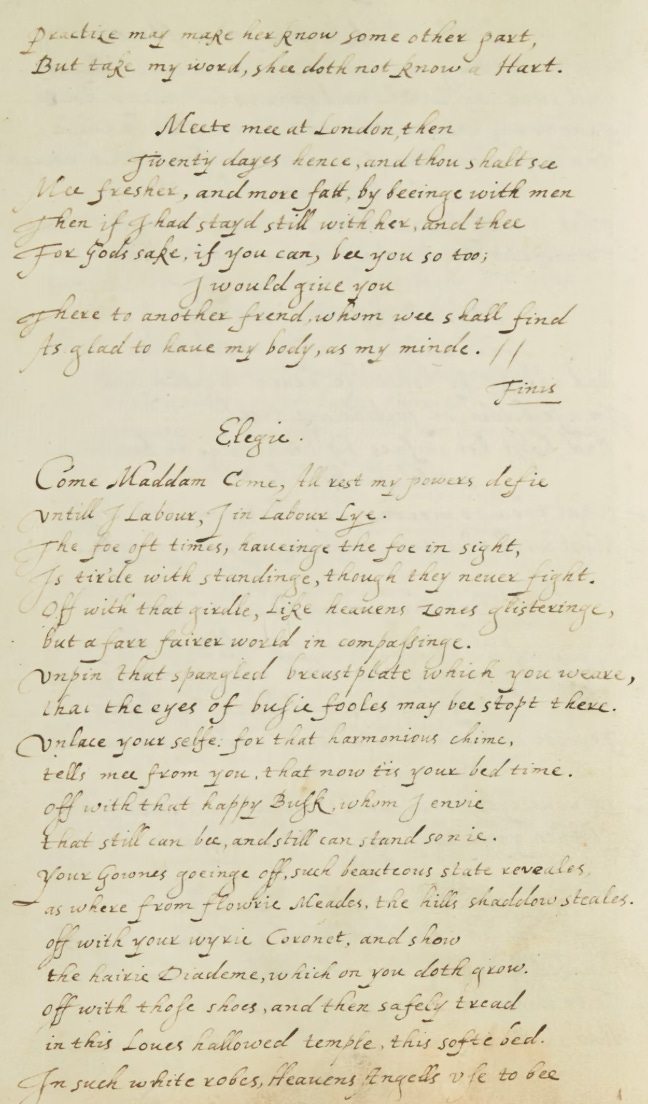
The Melford Manuscript of John Donne
***
Once I was done with reading all the takes on Lindy West and watching Couples Therapy, it seemed to be time to move on from thinking about out cultural obsession with the idea of needs and how that shapes our relationships. Instead, I saw the news that the woman who ran the sexual liberation group One Taste was sentenced to nine years in prison for coercing labor, including sexual labor, out of the members of her community. Which, of course, turned out to be a cult.
Based here in the Bay Area, One Taste was started by a woman named Nicole Daedone, who promised members that participating in “orgasmic meditation” would free women from the bonds of a patriarchal society. But Daedone also demanded forced labor from her devotees, including asking them to meet the sexual needs of wealthy men who funded the group, mostly against the women’s will. The coercive control Daedone practiced led many to label the group as a cult, but it was a cult disguised as a liberating form of sexuality. What promised to transform women by meeting their needs was instead about one woman using other women’s bodies as a tool to fund the needs of her own extravagant lifestyle.
The women who participated in One Taste mostly talk about it with a deep sense of sorrow. How much of themselves they were willing to surrender, and for what? Daedone is 58, a Gen Xer, but most of the women who joined One Taste were Millennials, drawn to the Bay Area’s early version of the tech world because it seemed like it had the potential to be a place for self-reinvention, the California mythos coupled with the internet’s licentiousness and permissiveness. Both the cult they unwittingly joined and the internet were a fantasy world, one where every need could be easily met.
Much of the writing in the Millennial wave of the internet involved women telling stories that you would cringe at if you overheard them at a party. Did those stories really need to be told? But they were addictive reading. A woman once wrote an essay called I Found A Ball of Cat Hair In My Vagina and we’re still talking about it today. One Taste meetings involved Daedone being masturbated by strangers onstage in front of a rapt audience. Polyamory means partners have to be honest about having sex with other people, often in graphic detail. Is there liberation in these things? Probably, in some form. But the tradeoff for one person’s liberation is that someone else always has to lose something.
The debate isn’t really about Lindy West, polyamory, monogamy, gender, or sexuality. It’s about the tradeoffs we all make between need and loss.
In church or in therapy, you go behind a closed door and tell a stranger all of the bad things you’ve done. Online, you do the same thing but you do it for thousands of people and it makes you sad, but you keep doing it because now it is your job. Regurgitating your private trauma is about meeting someone’s needs, but whose? Your own? We’re all voyeurs, and we all have needs. Some people’s needs will always rise to the top. Some people’s needs will be sublimated. Some will be forgotten with the passage of time and the erosion of our bodies and minds that accompanies it. But someone will always need something more than you do, and will be willing to hurt you in order to get it. And that pain can be transformative. But only you are the one who will bear it.